Where Dubai's rental yields are actually highest
Discovery Gardens returned 9.06% on apartments in H1 2026, double the Palm. The full community-by-community table from Bayut's H1 2026 report, plus what the percentage does and doesn't tell you.
There is a stubborn assumption in Dubai property that the best addresses make the best investments. On rental yield, the data says the opposite, and it is not close.
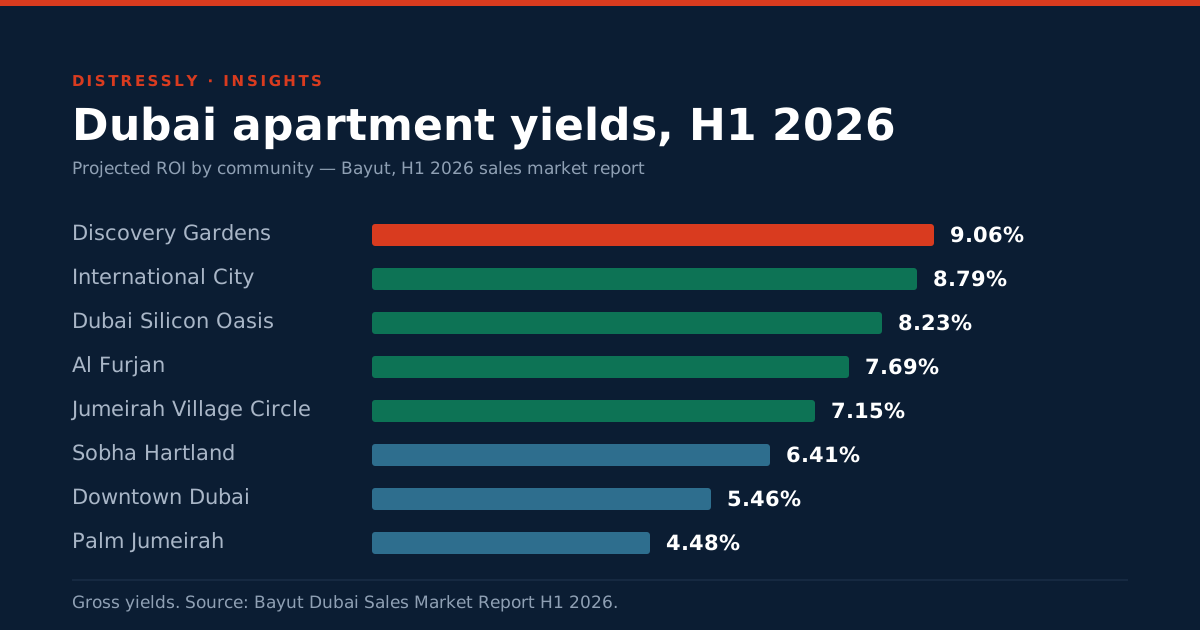
In the first half of 2026, the highest projected apartment return in Dubai came from Discovery Gardens at 9.06%. The lowest of the ultra-luxury communities, Palm Jumeirah, returned 4.48%. An investor buying on the Palm collected roughly half the yield, per dirham deployed, of one buying in Discovery Gardens.
Every figure below is Bayut's, from its Dubai Sales Market Report H1 2026 (published 29 July 2026). We have not adjusted, averaged or re-derived any of them.
Apartment yields by community, H1 2026
| Segment | Community | Projected ROI |
|---|---|---|
| Affordable | Discovery Gardens | 9.06% |
| Affordable | International City | 8.79% |
| Affordable | Dubai Silicon Oasis | 8.23% |
| Affordable | Dubai Sports City | 8.12% |
| Affordable | Dubai South | 7.24% |
| Mid-tier | Al Furjan | 7.69% |
| Mid-tier | Town Square | 7.45% |
| Mid-tier | Jumeirah Village Circle | 7.15% |
| Mid-tier | Arjan | 7.10% |
| Mid-tier | Business Bay | 6.29% |
| Luxury | Sobha Hartland | 6.41% |
| Luxury | Dubai Hills Estate | 6.30% |
| Luxury | Dubai Marina | 5.88% |
| Luxury | Downtown Dubai | 5.46% |
| Ultra-luxury | Al Barari | 6.49% |
| Ultra-luxury | Bluewaters Island | 5.01% |
| Ultra-luxury | Palm Jumeirah | 4.48% |
The ordering is almost perfectly inverted against price. That is not a quirk of
- It is arithmetic. Yield is rent divided by price, and in Dubai the price
side of that fraction scales far faster than the rent side as you move up the market.
You can see it directly in the two halves of the same report. An apartment in Dubai Silicon Oasis sold at an average of AED 1,086 per sq ft in H1 2026, against AED 6,091 per sq ft on Bluewaters Island, roughly 5.6× the price. But average annual rents, from Bayut's Dubai Rental Market Report H1 2026, ran to AED 467,000 on Bluewaters against AED 60,000 in International City, under 8×, on far larger units. Rent does not keep up with capital value, so the percentage falls as the address improves.
Villas tell the same story, more quietly
| Segment | Community | Projected ROI |
|---|---|---|
| Mid-tier | DAMAC Lagoons | 6.09% |
| Mid-tier | Jumeirah Village Circle | 6.04% |
| Luxury | Jumeirah Golf Estates | 6.04% |
| Affordable | DAMAC Hills 2 | 5.97% |
| Affordable | International City | 5.66% |
| Mid-tier | Mudon | 5.34% |
| Luxury | Tilal Al Ghaf | 5.27% |
| Affordable | Dubailand | 5.23% |
| Mid-tier | DAMAC Hills | 4.95% |
| Affordable | Dubai South | 4.92% |
| Mid-tier | Al Furjan | 4.56% |
| Luxury | Dubai Hills Estate | 4.30% |
| Ultra-luxury | Pearl Jumeirah | 3.98% |
| Ultra-luxury | Palm Jumeirah | 3.95% |
| Ultra-luxury | Jumeirah Islands | 3.89% |
| Luxury | Arabian Ranches | 3.87% |
Two things stand out. Villa yields sit below apartment yields almost everywhere, the best villa community in Dubai returned less than the fifth-best apartment community. And Al Barari breaks the pattern, at 6.37% on villas and 6.49% on apartments, the only ultra-luxury community that competes on income rather than only on capital.
What the percentage does not include
This matters more than the ranking, so we will be blunt about it: these are gross yields. They are annual rent divided by purchase price, and nothing else has been deducted. A real net return has to survive:
- Service charges, which vary enormously by building and are the single largest gap between gross and net in Dubai.
- Vacancy between tenants, and the commission to fill it.
- Management and maintenance, if you are not doing it yourself.
- Purchase costs: the DLD transfer fee, agency, conveyancing, which the yield calculation ignores entirely because they sit outside the purchase price.
A headline 9% and a realised 9% are different numbers. Anyone quoting you the first as though it were the second is selling, not advising.
There is a second limit worth naming. A projected ROI is built from average rent over average price for a community. Inside any of these communities, an individual building can sit well above or well below its area's average, and a single unit can sit well outside its building's. The table tells you where to look. It does not underwrite a specific apartment.
The market these yields sit inside
Dubai's transaction volume gives the numbers their context. Per the Dubai Land Department, Q1 2026 alone recorded AED 252 billion in total transactions, a 31% year-on-year rise in value on a 6% rise in volume. Value climbing five times faster than volume means the average deal got larger, not that more people bought.
The DLD also recorded 29,312 new investors in the quarter, up 14%, within a total investor base of 48,448. Foreign investment reached AED 148.35 billion, up 26%.
That combination, rising prices on flat volume with new money arriving, is exactly the condition under which gross yields compress. If prices rise faster than rents, every percentage in the tables above drifts down, regardless of how well any individual community performs.
Why entry price is the lever you actually control
Yield has two inputs and you only negotiate one of them. Market rent for a two-bedroom in JVC is what the market will pay; it is not moved by how well you bought. The purchase price is.
The arithmetic is unforgiving in a useful direction. Yield scales by 1 ÷ (1 − discount), so buying below the price a yield was calculated on raises that yield:
| Bought below market | A 7.15% community yield becomes |
|---|---|
| 5% | 7.53% |
| 10% | 7.94% |
| 15% | 8.41% |
| 20% | 8.94% |
Those are not forecasts and they are not claims about any listing, they are just the yield formula applied to a lower denominator, using JVC's 7.15% as the starting point. A 20% discount moves a mid-tier community into affordable-tier yield territory without changing the asset.
This is the entire reason Distressly exists. We do not publish a listing until a reviewer has checked what backs it, and we calculate every discount ourselves from the documented original price rather than repeating a seller's claim. A discount you cannot verify does nothing for your yield.
Sources
- Bayut, Dubai Sales Market Report H1 2026, published 29 July 2026. Projected ROI by community and segment; average sales price per sq ft.
- Bayut, Dubai Rental Market Report H1 2026, updated 28 July 2026. Average annual rents by community and segment.
- Dubai Land Department, Dubai's real estate transactions surge 31% to reach AED 252 billion in Q1 2026, published 9 April 2026. Transaction value and volume, investor counts, foreign investment.
Every figure in this article is reproduced from a named source above and linked at the point it is used. Where we have applied arithmetic of our own, the discount table, we have said so and shown the formula. Yields are gross and are projections, not guarantees. This is market commentary, not investment advice.