Where distressed Dubai deals appear as the market cools
Dubai home sales cooled about 14% in H1 2026, led by off-plan. Here is why a softer, normalising market surfaces more genuine below-original-price deals.
For four years the only Dubai property story was up. From 2021 to 2024 prices climbed, volumes climbed, and almost anything bought almost anywhere gained. H1 2026 is a different chapter, and it is a more useful one if you are hunting a genuine deal rather than riding a wave.
The headline is not a crash. It is a cooling, and a cooling market is precisely the condition under which below-original-price opportunities stop being rare.
The H1 2026 numbers, plainly
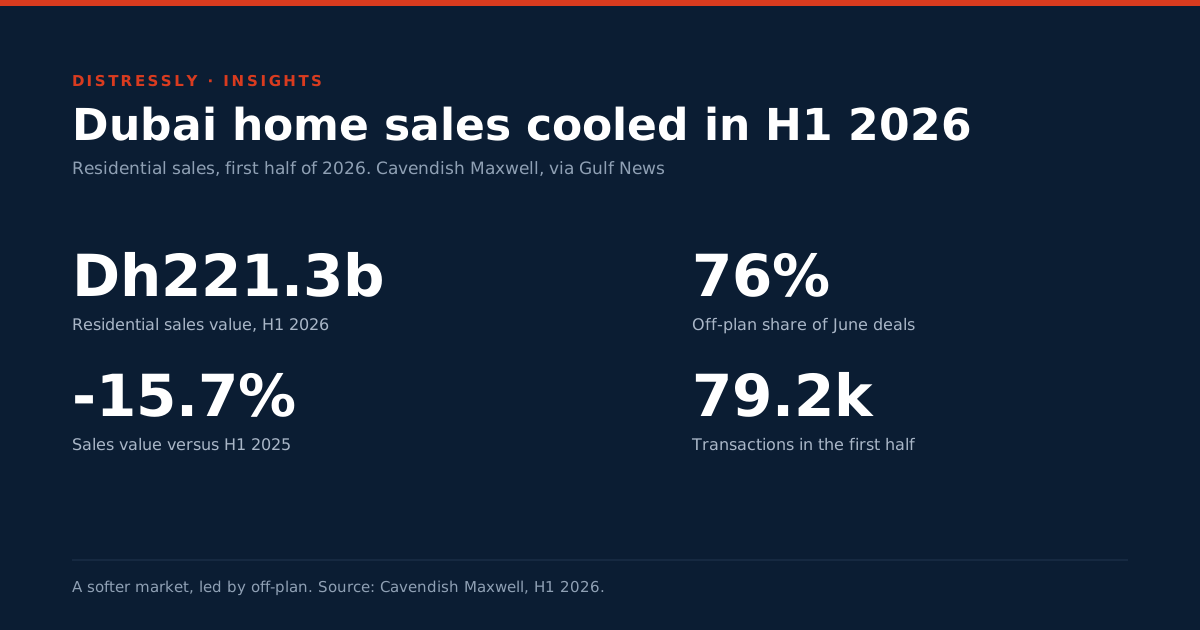
Dubai residential sales in the first half of 2026 came to Dh221.3 billion across roughly 79,200 transactions, per property consultancy Cavendish Maxwell, reported by Gulf News (6 July 2026). That is still an active market, and the second-strongest first half on record, but it sits below H1 2025: transaction volume was down about 14% and total sales value down about 15.7% year on year.
| Measure, H1 2026 | Figure | Versus H1 2025 |
|---|---|---|
| Residential sales value | Dh221.3 billion | Down about 15.7% |
| Residential transactions | About 79,200 | Down about 14% |
| June transactions | 12,315 | Up about 30% on May |
| June off-plan share | 76% of deals | Off-plan led |
Two things sit inside those numbers. First, the fall in value was slightly steeper than the fall in volume, which means the average deal got a little smaller, not just less frequent. Second, the market did not stall: after a quieter May around the Eid holiday, June rebounded almost 30% month on month, with 12,315 transactions worth Dh25.17 billion. Demand cooled, it did not disappear.
For the wider picture, the Dubai Land Department reported total real-estate transactions of AED 252 billion in Q1 2026, up 31% in value on a 6% rise in volume. Value outrunning volume early in the year, then values easing in the second quarter, is the shape of a market normalising rather than collapsing.
Why a cooling market helps a distress buyer
A rising market hides motivated sellers. When every unit gains month after month, an owner who needs to sell can wait a few weeks and clear at a full price, so genuine discounts are scarce and short-lived. When the market flattens, that cushion goes. An owner facing a real deadline, a relocation, a mortgage reset, a portfolio decision, no longer has time or price appreciation on their side, and that is when a documented below-original-price sale becomes possible.
None of this is a claim that prices are about to tumble. It is the simpler point that a softer market widens the gap between what a patient buyer will pay and what a pressured seller must accept. That gap is the entire raw material of a distress deal.
Off-plan led the fall, and that matters
The cooling was not evenly spread. Off-plan accounted for 76% of June transactions, and off-plan is where the boom-era speculation concentrated, buyers who purchased to flip a contract before handover rather than to hold. As launches keep arriving and the easy resale premium narrows, some of those buyers become sellers who need an exit, not a top price.
What this means if you are buying ready
Ready, secondary-market homes behave differently from off-plan. They come with a title deed you can verify today, a service-charge history you can read, and comparables that already trade. In a cooling market that transparency is worth more, not less, because you are checking a real asset against real evidence rather than a projection.
You can browse the two segments separately on Distressly: ready resale homes and off-plan. If your priority is the size of the documented gap rather than the segment, filter straight to listings at 10% or more below original price.
A softer market does not make every discount real
Here is the trap. When sentiment cools, the word "discount" appears on far more listings, because it is the easiest thing to print. A softer market is exactly when you should tighten your checks, not loosen them. A real saving is measured against a documented original price and survives the full cost picture; a manufactured one is measured against a number the seller invented. We wrote the full checklist in Top 10 signs a property discount is real.
This is why Distressly reviews every listing before it publishes and calculates each discount from the documented original price rather than repeating a seller's claim. In a flat market that discipline is the difference between a deal and a story about a deal.
The one input you actually control
Yield is rent divided by price, and you only negotiate one of those two numbers. Market rent for a two-bedroom in a given community is what tenants will pay; it does not move because you bought well. The purchase price does. Buying below the price a yield was calculated on lifts that yield by 1 ÷ (1 − discount), so a 10% saving turns a 7.15% community yield into roughly 7.94%, without changing the asset. We set out the full community-by-community picture in Where Dubai's rental yields are actually highest, and you can run your own numbers with the investment tools.
Those are projections, not guarantees, and they are gross of service charges, vacancy and purchase costs. The arithmetic simply shows why entry price is the lever worth pushing hardest in a market that is no longer doing the work for you.
How to use a cooling market well
- Start from the documented gap, not the asking price. Browse current deals and sort by the biggest verified discount.
- Treat sold listings as evidence. The sold deals show what actually cleared, not just what was hoped for.
- Watch the regulation and supply backdrop on the news page, because rules and pipeline shape where pressure lands next.
A cooling market rewards the buyer who checks. The evidence is more available, the sellers are more motivated, and the discount, when it is real, is easier to prove. That is the market Distressly was built for.
Sources
- Gulf News, Dubai homes record Dh221.3b sales in first half of 2026, published 6 July 2026. Residential sales value and volume for H1 2026, year-on-year change, June rebound and off-plan share, per Cavendish Maxwell.
- Dubai Land Department, Dubai's real estate transactions surge 31% to reach AED 252 billion in Q1 2026, published 9 April 2026. Total transaction value and volume for Q1 2026.
Every figure above is reproduced from a named source and linked where it is used. The yield arithmetic is our own and shown as a formula; yields are gross and are projections, not guarantees. This is market commentary, not investment advice.